Postpartum Rage: Why Am I So Angry After Having a Baby?
A free resource provided by: Psychology House - Tampa, FL
Introduction
It's 2 a.m. The baby has been crying for what feels like an hour. You've tried everything you know to try. Your partner is asleep, or maybe they're up too and just asked, at exactly the wrong moment, "did you try burping her again?" And something in you snaps. You feel heat rise up through your chest and into your face. You want to scream, or throw the bottle across the room, or slam a cabinet door hard enough to make the whole kitchen shake. Maybe you do. And then, almost as fast as it came, it's gone, and what's left is worse than the anger itself: shame. What is wrong with me? I'm not supposed to feel this way about my own baby, my own life.
If any of that sounds familiar, especially in the middle of a Tampa summer with the AC running and a newborn who won't settle, you're not broken, and you're not alone. What you're describing has a name. It's called postpartum rage, and it happens to far more new moms than the quiet around the topic would suggest.

What Is Postpartum Rage?
Postpartum rage is sudden, intense anger that shows up in the weeks or months after having a baby, often in a way that feels completely out of character. It's not the low-grade crankiness of running on four hours of sleep. It's a much bigger wave: a hot, fast surge of fury that seems to come out of nowhere, followed almost immediately by guilt over how big the reaction felt.
Postpartum rage isn't an official medical diagnosis on its own, but healthcare providers and researchers increasingly recognize it as a real and common experience, often connected to postpartum anxiety or postpartum depression. According to Postpartum Support International, one of the leading nonprofits focused on maternal mental health, perinatal mood and anxiety concerns are the most common complication of childbirth, and anger is one of the least talked-about symptoms in that picture.
You'll also hear this called "mom rage." Postpartum rage and mom rage are basically the same experience described two different ways — mom rage is the more casual, social-media-born term, while postpartum rage is the phrase you're more likely to hear from a clinician. Either way, they're pointing at the same thing: anger that feels sudden, disproportionate, and hard to control.
Is Postpartum Rage Normal?
Yes. Postpartum rage is a normal, common response to an extraordinarily demanding period of life, even though it rarely gets talked about the way postpartum sadness or worry does. Research suggests something like one in five new mothers experiences significant anger in the postpartum period, and many more feel flashes of it without ever naming it out loud.
That said, "normal" doesn't mean "ignore it." Common experiences can still be worth paying attention to, especially if the anger is frequent, feels bigger than the moment calls for, or is starting to affect how you feel about yourself, your partner, or your baby. Rage that shows up occasionally during an exhausting week is different from rage that's become a daily pattern. Both are valid to talk to someone about — but the second one deserves more urgency.
What Does Mom Rage Actually Feel Like?
If you've experienced it, you probably don't need this section to convince you it's real. But it helps to know you're not imagining the intensity of it, and that other mothers describe it in almost identical terms.
Mothers going through it often describe:
A sudden heat or burning sensation rising through the chest, neck, or face
Going from calm to furious in seconds, with almost no space to catch it before it happens
An urge to yell, slam something, or physically release the pressure building inside
Snapping at a partner, older child, or even the baby over something minor
An almost immediate crash into guilt, shame, or fear afterward
Therapists who work in this space often describe a three-part cycle: buildup, explosion, aftermath. The buildup is the slow accumulation of stress, sensory overload, and unmet needs — the noise, the touch, the constant demands of caring for a newborn. The explosion is the yelling, the slammed door, the sharp words. And the aftermath is the flood of shame that follows, which, left unaddressed, often feeds right back into the next buildup. Recognizing that cycle is often the first real step toward interrupting it.
Why Does Postpartum Rage Happen?
There's rarely one single cause. Postpartum rage tends to be the collision of several things happening in your body and life all at once.
Your hormones are in free fall. During pregnancy, estrogen and progesterone climb steadily for nine months. In the days after birth, both drop sharply and suddenly. That kind of hormonal whiplash has a real, physiological effect on mood regulation — it's not "just in your head," it's chemistry.
Your nervous system is overloaded. When your baseline stress is already high, your brain's threat-detection system runs hot, constantly scanning for danger. In the context of a newborn, that means every cry, every unexpected noise, every unmet need can register as an emergency rather than a normal part of the day. Add in the physical experience of being touched, held onto, and needed around the clock — often called being "touched out" — and it's easy to see how your senses can hit their limit well before dinner.
You're exhausted and carrying an invisible load. Sleep deprivation alone makes almost anyone more irritable and less able to regulate strong emotion. Stack that on top of the mental load new mothers often carry largely alone — remembering the pediatrician appointment, tracking what size diapers you're on, knowing who's bringing dinner this week — and it's no wonder the smallest thing can feel like the last straw.
None of these causes make the rage your fault. They're the reason it's happening, not evidence that something is wrong with you as a mother.
Postpartum Rage vs. Postpartum Depression vs. Postpartum Anxiety
These three often get lumped together, and they frequently do overlap, but they're not the same experience.
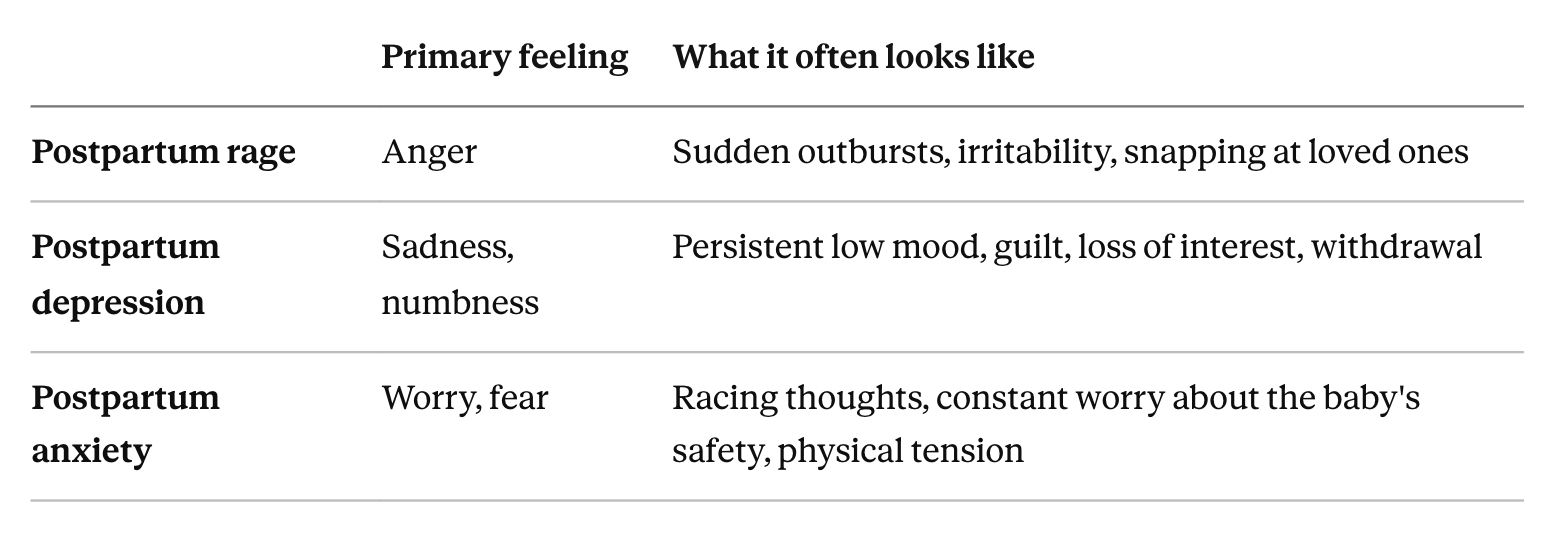
It's entirely possible to experience rage without depression, or depression without much anger at all. It's also common to have some combination of all three at once. The label matters less than the fact that you're struggling and that support exists either way.
How Long Does Postpartum Rage Last?
There's no single timeline, and that uncertainty is often part of what makes it so unsettling. For many mothers, postpartum rage is most intense in the first three to six months after birth, gradually easing as hormones begin to stabilize, sleep improves, and routines settle into something more predictable.
For others, it can last longer — especially when the underlying contributors don't get addressed. Ongoing sleep deprivation, a lack of practical or emotional support, unprocessed birth trauma, or untreated postpartum anxiety can all keep the cycle going well past that six-month mark, sometimes into the second year.
The most useful way to think about it: postpartum rage isn't really the problem on its own. It's a signal. It's your body and mind telling you that something underneath — rest, support, unprocessed emotion, or an anxiety disorder that hasn't been named yet — needs attention.
What Actually Helps With Postpartum Rage
You can't will yourself out of a hormonal and nervous-system response through sheer effort, but there are things that genuinely help lower the temperature.
Protect small stretches of real sleep. Even a single uninterrupted three- or four-hour block can measurably change your emotional bandwidth for the next day.
Offload the mental load where you can. Ask a partner to own a specific piece of it — the pediatrician calls, the diaper stock, the dinner plan — rather than "helping" on request. Handing off a whole category of responsibility matters more than an extra hour here and there.
Name the pattern out loud. Telling a partner, a friend, or a therapist "I think I'm experiencing postpartum rage" tends to loosen its grip. Rage that stays secret tends to feed the shame cycle that follows it.
Build in small sensory breaks. A few minutes without being touched, held onto, or spoken to can help an overloaded nervous system reset, even if it's just standing alone in the bathroom for two minutes.
Get support that's trained specifically in this. Therapy with a perinatal mental health background can help you understand what's actually driving the rage and give you real tools to interrupt the cycle earlier — before the explosion, not just after it.
When to Get Help for Postpartum Rage
Reaching out for support is never premature, but there are specific signs that mean it's time to move from "I should probably talk to someone eventually" to "I need to talk to someone now."
Reach out right away if the anger is affecting your relationships or your ability to care for yourself or your baby, if it's happening frequently and feels impossible to interrupt, or if you notice confusion, disorientation, or thoughts that feel disconnected from reality — which can be signs of postpartum psychosis, a rare but serious condition that needs immediate care.
If you're having any thoughts of harming yourself or your baby, please don't wait. Call or text 988 to reach the Suicide & Crisis Lifeline, or go to your nearest emergency room. That's not a sign you've failed as a mother. It's a sign your body is asking for more support than you can provide alone right now, and getting it is the right next step.
Support for Postpartum Rage in Tampa
You don't have to figure this out by yourself, and you don't have to do it in isolation. Tampa has a genuinely active community of people who understand this stage of motherhood — organizations like the Tampa Bay Birth Network and MOST (Moms of South Tampa) connect new mothers with doulas, lactation consultants, and each other, and plenty of that support is built specifically around the exhaustion and overwhelm of the fourth trimester.
At Psychology House, our maternal mental health specialist, Rachel Brunelle, works with South Tampa moms navigating exactly this: the anger that shows up out of nowhere, the guilt that follows it, and the exhaustion underneath both. If postpartum rage, anxiety, or overwhelm have been showing up in your day to day life, she would be happy to talk with you. You can learn more about our maternal mental health services or reach out to schedule a consultation. Rachel offers in-person sessions at our Tampa office and Teletherapy for Florida and Georgia residents.
You are allowed to love your baby fiercely and still feel furious some days. Both things can be true. Neither one makes you a bad mother — it makes you a human being carrying an enormous amount, often with very little sleep and even less help. Rage is often tangled up with a bigger shift happening underneath it — the identity earthquake of becoming a mother, something we've written about in What Is Matrescence? Understanding the Identity Shift That Comes With New Motherhood
Frequently Asked Questions
Is postpartum rage normal?
Yes. Postpartum rage is a common experience — research suggests roughly one in five new mothers reports significant anger in the postpartum period. Common doesn't mean it should be ignored, though; if it's frequent or intense, it's worth talking to a professional.
How long does postpartum rage last?
There's no fixed timeline. For many mothers, it's most intense in the first three to six months and eases as sleep and hormones stabilize. It can last longer if sleep deprivation, lack of support, or untreated anxiety continue unaddressed.
What's the difference between postpartum rage and postpartum depression?
Postpartum rage centers on sudden anger and irritability, while postpartum depression centers on persistent sadness, numbness, or guilt. They often overlap, but you can experience one without the other.
What triggers postpartum rage?
Common triggers include sensory overload from being touched or needed constantly, sleep deprivation, hormonal shifts after birth, and the invisible mental load of caring for a newborn. Small moments — a crying baby, an unhelpful comment — often become the final trigger after a longer buildup.
Can postpartum rage happen without depression?
Yes. Rage and depression frequently occur together, but many mothers experience significant anger with little or no sadness, and vice versa. They're related but distinct experiences.
When should I worry about postpartum rage?
Reach out for support if the rage is frequent, feels unmanageable, or is affecting your relationships or ability to care for your baby. Seek immediate help by calling or texting 988 or going to the nearest emergency room if you have any thoughts of harming yourself or your baby, or if you notice confusion or hallucinations.
Psychology House is located at 3414 W Bay to Bay Blvd, Suite 100, South Tampa, FL 33629. We offer in-person therapy in Tampa and online therapy throughout Florida.