Postpartum Intrusive Thoughts: Why New Moms in Tampa Have Scary Thoughts (And What's Actually Normal)
A free resource provided by: Psychology House - Tampa, FL
Introduction
You're standing at the top of the stairs, holding your baby, and out of nowhere your brain shows you a flash of dropping her. You're driving home over the Gandy Bridge with your newborn asleep in the back seat, and a thought pops in about swerving into the water. You're giving your son a bath, and suddenly you picture something terrible happening — something you would never, ever want.
And then the panic hits. What is wrong with me? Why did I just think that? Does this mean I'm a danger to my own baby?
If this sounds familiar, take a moment to breath a few relieving breaths. You are not a bad mom. You are not alone. And what you're describing has a name — postpartum intrusive thoughts — and it is far more common, and far less dangerous, than it feels in the moment. This article walks through what these thoughts are, why they happen, how to tell them apart from something more serious, and where to find support here in Tampa.

What Are Postpartum Intrusive Thoughts?
Postpartum intrusive thoughts are sudden, unwanted thoughts or mental images that pop into a new parent's mind, usually centered on the baby being harmed. They can show up as a flash of accidental harm (the baby falling, choking, or getting hurt in a car accident) or, more distressing, as an unwanted thought about the parent intentionally causing harm. Some parents describe disturbing images; others describe worries about contamination or illness.
Here's the part that matters most: these thoughts are the opposite of a warning sign. They feel completely out of character because they are out of character. The horror, the shame, and the "why would I think that" reaction you have afterward is actually the clearest evidence that the thought doesn't reflect what you want or who you are. Mental health professionals call this "ego-dystonic" — the thought clashes with your values so sharply that it produces intense distress, not agreement.
You're Not Alone
If you take away one statistic from this article, make it this one: research published in the Journal of Clinical Psychiatry and other peer-reviewed studies has found that somewhere between 70% and 100% of new mothers report unwanted, intrusive thoughts about their infant being harmed in some way. Roughly half report thoughts specifically about intentional harm — and study after study finds no evidence that having these thoughts makes someone more likely to act on them. They tend to peak in the first few weeks after birth and gradually ease for most parents.
In other words, if you're experiencing this, you are in the overwhelming majority of new parents — not some rare, alarming exception.
That said, common doesn't always mean easy. New parenthood in a city like Tampa can amplify the isolation that makes these thoughts feel so much heavier. Maybe your family isn't nearby. Maybe the summer heat keeps you inside more than you'd like, cutting off the walks and mom-group meetups that used to break up the day. Maybe you're managing a newborn's schedule around a partner's long commute up I-275. None of that causes intrusive thoughts, but it can make the isolation and exhaustion that come with them harder to carry alone — which is exactly why naming what's happening, and knowing you're not the only one, matters so much.
Postpartum Intrusive Thoughts vs. Postpartum Psychosis — Know the Difference
This is the single most important distinction in this entire article, so we're putting it right up front.
Postpartum intrusive thoughts (often connected to postpartum OCD) are unwanted. The parent is horrified by them, recognizes them as wrong, and often goes out of their way to avoid situations that trigger them — like avoiding knives in the kitchen or staying extra careful near stairs. The person having these thoughts stays firmly grounded in reality. They know the thought is just a thought.
Postpartum psychosis is a completely different, much rarer, and much more serious condition. It can involve delusions, hallucinations, disorganized thinking, or a break from reality. A parent experiencing psychosis may not recognize that anything is wrong, and may act in line with delusional beliefs rather than being horrified by them. Postpartum psychosis is a medical emergency and requires immediate care.
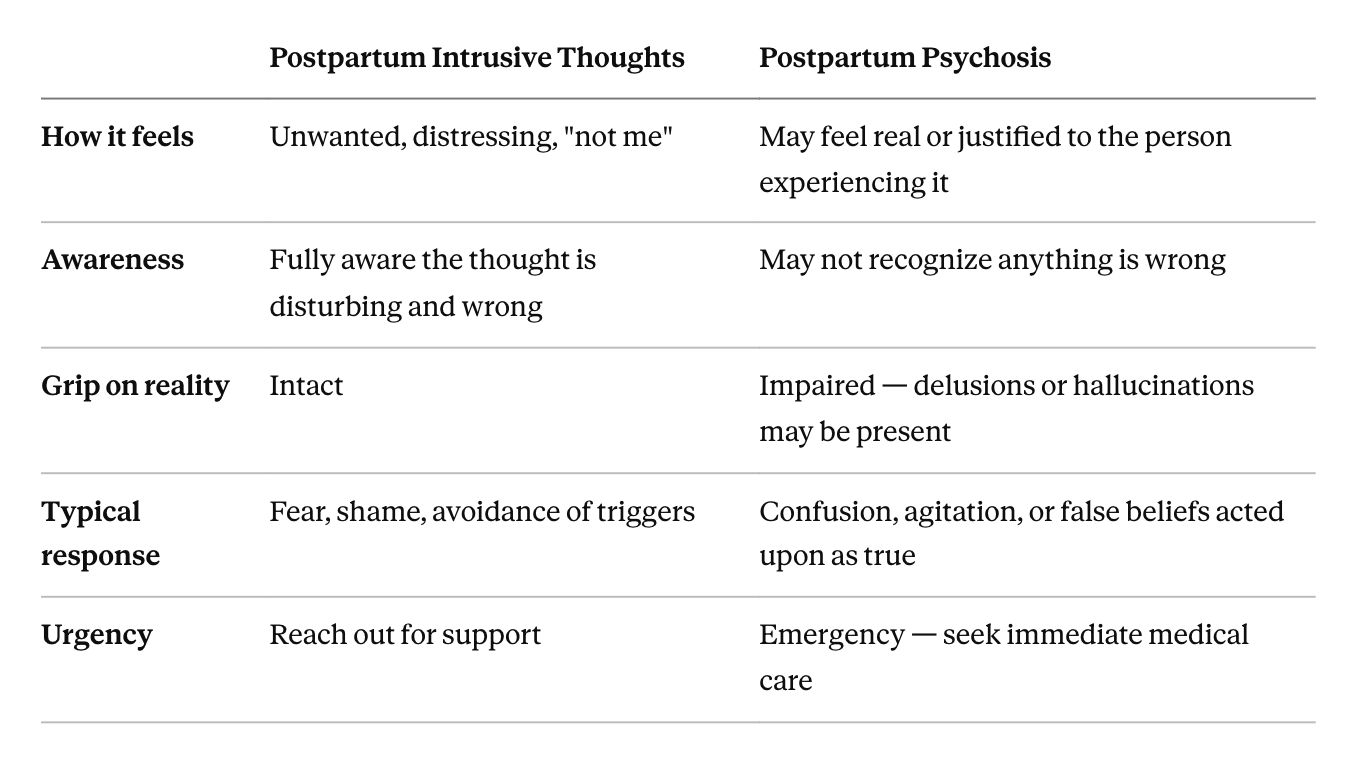
If you're worried you might act on a thought, or if you're experiencing confusion, hallucinations, or a sense that something isn't real, please reach out right now:
Call or text 988 (Suicide & Crisis Lifeline) — available 24/7
Postpartum Support International HelpLine: 1-800-944-4773 — free, confidential support for perinatal mental health (note: this is not a crisis line; for emergencies, use 988 or go to your nearest ER)
Go to your nearest emergency room or call 911 if there is any immediate risk
Why Do These Thoughts Happen?
It can help to understand what's actually going on in your brain, rather than just being told "it's normal" and left to take it on faith.
New parenthood puts your nervous system on high alert. Hormonal shifts after birth, combined with severe sleep deprivation, ramp up the brain's threat-detection system — the same system that's supposed to help you notice danger and protect a completely helpless newborn. For most parents, that heightened vigilance shows up, at least occasionally, as unwanted "what if" thoughts about the worst-case scenario. It's an overcorrection of a very natural, very protective instinct.
There's also an identity piece at play. Becoming a mother reshapes your sense of self — a process sometimes called matrescence — and that upheaval can bring a wave of anxiety about your own competence and your ability to keep this new person safe. We've written in more depth about that identity shift and what it looks like for new moms in Tampa, because understanding it can take a lot of the mystery — and the fear — out of what you're feeling right now.
How Postpartum Intrusive Thoughts Are Different From Postpartum Rage
If you've also found yourself snapping, feeling a flash of white-hot anger over something small, or feeling frightened by the intensity of your own irritability since having your baby, you might be wondering if that's connected to what we're talking about here. It's related, but it's a different experience. Intrusive thoughts are internal and involuntary — they show up uninvited and cause distress, without you doing anything. Postpartum rage, on the other hand, is more of an emotional and behavioral symptom — a surge of anger or reactivity that gets expressed outwardly, often followed by guilt. Many parents experience both at different points in the postpartum period, and neither one means something is fundamentally wrong with you as a parent. If postpartum rage sounds like what you've been dealing with, we go into it — and what actually helps — in this post on postpartum rage in Tampa moms.
When to Seek Support
Having an occasional intrusive thought doesn't necessarily mean you need therapy — for most parents, these thoughts are common and pass without professional treatment. That said, it's worth reaching out to a perinatal-trained therapist if:
The thoughts are frequent or nearly constant
They're causing significant distress, anxiety, or guilt that doesn't ease up
You're avoiding normal caregiving tasks (bathing, feeding, being alone with the baby) because of the thoughts
The thoughts are interfering with bonding, sleep, or your day-to-day functioning
You notice any of the psychosis warning signs above
Reaching out early isn't an overreaction. It's usually the fastest way to get relief — and it means you don't have to keep carrying this alone.
Treatment That Works for Postpartum Intrusive Thoughts
The good news is that postpartum intrusive thoughts, including when they rise to the level of postpartum OCD, respond well to treatment. A few approaches your provider may discuss with you:
Cognitive Behavioral Therapy (CBT): Helps you understand the thought patterns driving your anxiety and build tools to respond to unwanted thoughts differently.
Exposure and Response Prevention (ERP): A specialized form of CBT used specifically for OCD-spectrum symptoms. ERP gently and gradually helps you tolerate the discomfort of an intrusive thought without engaging in avoidance or compulsive behaviors, which over time reduces the thought's grip on you.
Medication: For some parents, a conversation with a prescriber about SSRIs or other options is a helpful piece of the puzzle, especially alongside therapy. This is a decision to make together with a provider who understands perinatal mental health.
Treatment isn't about "fixing" you — it's about giving your nervous system the support it needs to come back down from high alert.
Getting Support in Tampa
If any of this feels close to home, you don't have to figure it out on your own. At Psychology House, our South Tampa practice on W Bay to Bay Blvd, Rachel Brunelle, RMHCI, specializes in maternal mental health — including postpartum anxiety, intrusive thoughts, and the broader identity shifts that come with new motherhood. Rachel understands how isolating and frightening these thoughts can feel, and how much relief comes from finally saying them out loud to someone who won't flinch or judge.
If you're ready to talk to someone, we'd love to help you take that first step. Reach out to schedule a free consultation, and let's figure out the right support for where you are right now.
You Are Not a Bad Mom
If you remember nothing else from this article, remember this: having a scary thought about your baby doesn't mean you want it to happen. It doesn't mean you're unfit, unsafe, or somehow different from every other exhausted, overwhelmed, deeply loving new parent scrolling the internet at 3 a.m. looking for answers. The very fact that these thoughts terrify you is proof of how much you love this baby — not evidence against it. You're allowed to ask for help. You're allowed to feel scared and still be a wonderful mother. And this feeling, as heavy as it is right now, does get lighter.
A note on crisis support: If you are ever worried you might act on a thought, or you're experiencing confusion, hallucinations, or a break from reality, please don't wait — call or text 988 (Suicide & Crisis Lifeline), call the Postpartum Support International HelpLine at 1-800-944-4773, or go to your nearest emergency room.
This article is for educational purposes only and isn't a substitute for individualized evaluation or treatment from a licensed mental health provider.
Frequently Asked Questions
Are intrusive thoughts about your baby normal?
Yes. Research shows that between 70% and 100% of new parents experience unwanted, intrusive thoughts related to their baby being harmed. They're one of the most common — and most under-discussed — experiences of early parenthood.
What's the difference between postpartum OCD and postpartum psychosis?
Postpartum OCD involves unwanted thoughts that the parent recognizes as distressing and wrong, while staying fully grounded in reality. Postpartum psychosis is a rare, serious condition involving delusions, hallucinations, or a break from reality, and requires immediate medical attention.
Do intrusive thoughts mean I'll act on them?
No. Research has found that having these thoughts does not increase the likelihood of acting on them. In fact, the distress and disgust a parent feels in response to the thought is a sign that it goes against what they actually want.
How do you get rid of postpartum intrusive thoughts?
For many parents, the thoughts ease naturally as sleep improves and the early postpartum period passes. If they persist or cause significant distress, therapy — particularly CBT and Exposure and Response Prevention (ERP) — along with support from a perinatal-trained provider can be very effective.
When should I worry about postpartum intrusive thoughts?
Reach out to a professional if the thoughts are frequent, distressing, or interfering with daily life or bonding with your baby. Seek immediate help if you experience any loss of touch with reality, hallucinations, or fear that you might act on a thought.
Psychology House is located at 3414 W Bay to Bay Blvd, Suite 100, South Tampa, FL 33629. We offer in-person therapy in Tampa and online therapy throughout Florida.